The leaves are starting to turn colour. The evening air has a crispness that only means one thing: it’s back to school!
No matter how old I am, September always arrives with a bit of excitement for me. It’s kind of like New Year’s without the snow and without the pressure of resolutions. September used to mean new crayons, notebooks, clothes, and other goodies to hopefully make the upcoming school year a bit brighter. It meant new classes, new people (maybe), and just an overall newness to everything. But alas, my excitement did not last that long, and by October I was well over the novelty of having to get up in the morning and sit through boring lectures about who knows what.
As a parent, September meant my days would be mine again. The kids would be back in school, and I would not have to invent ways to entertain them 24-7. For the next 10 months that chore would fall to someone else (yay teachers!)
September is a time for learning. A time to try new things. A time to plan. And there is no reason that should stop just because I’m past 60.
My friend Kathie gave me a copy of an article that she thought I might find interesting. That article is Starting Fresh: Why It’s Not Too Late to Learn New Skills, by Margaret Talbot, staff writer, The New Yorker, Jan. 11, 2021. The type is quite small, and I am struggling to get through it, even with my fancy new glasses. Unfortunately, when I tried to read it online, I would only get a few seconds in and then could go no further without a subscription. I did find an online narration, and if you can be patient with the reader’s mispronunciations and dictionary checks, it’s pretty good.
Anyway, in her article, Talbot talks about learning new things at an older age. “One problem with teaching an old dog new tricks is that certain cognitive abilities decline with age, and by age, I mean starting as early as one’s twenties. Mental processing speed is the big one.”
Sure, there are things that a younger brain can do better than an older brain, but let’s not forget the things an older brain excels at. An article on Webmd.com lists several things an older brain may be better at verbal abilities, inductive reasoning, visual-spatial skills, basic math, tuning out negativity, and being content. Hmmmm. My inductive reasoning, or my ability to problem solve, has never been all that great. Maybe there’s still hope? And my visual-spatial skills are lacking. Does this mean that I will soon be able to parallel park? Yay! I must admit that my basic math skills have improved over the years. My methods may be a bit convoluted (let’s see, that was three years before my oldest daughter was born, so that is 89 minus 3 equals AHA 86!) My high school math teacher must be turning over in his grave.
Simon Fraser University (SFU) has a seniors program whose motto is “You don’t stop learning when you grow old; you grow old when you stop learning. I love that! Many universities do see the value of providing non-credit classes for seniors, and with online options available, there is no shortage of choices. The University of Saskatchewan, located in my city, offers inexpensive, non-credit classes through Saskatoon Seniors Continued Learning (SSCL), in collaboration with the College of Arts & Science. A friend of mine took a couple of classes through SSCL and really enjoyed interacting with other “older” students, learning about their viewpoints and, of course, learning about the subject of interest. There are also a lot of workshops and lectures available for seniors offered through community groups. I’m excited to attend two sessions this fall. One is Chair Pilates, and the other is dreaming. You can rest assured there will be a blog about that topic!
I’ve never been good at remembering details, details such as the name of the book, the author, or who starred in a movie. I enjoy the book or movie at the time, but then, whoosh, it’s gone. This is getting worse as I age. That’s okay. It’s not like I need good grades anymore or another point on my resume. I don’t need to impress anyone with witty conversation or important trivia. So why bother with learning anything new?
Gasp! Shut the front door!
Learning is to the brain what physical exercise is to the rest of the body. Most of us who are in our sixties and up are quite concerned about changes happening to our physical health and how we can keep in shape, lose weight, build muscle, improve flexibility, etc. Push, push, push! We need to do the same for our brain—keep it in shape and ready to think, lose weight, or clutter. My brain has a lot of useless stuff taking up real estate. We need to make our brains stronger and improve the flexibility of our thoughts. As older adults, we have had a lot of years to develop a certain mindset, but that doesn’t mean we can’t expand our way of thinking, or maybe even change it.
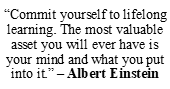
Learning new things gives us a sense of purpose and achievement. It also brings people together and creates valuable social connections. And learning something new can help to keep our memories sharp and our brains clear and focused.
The concept of lifelong learning is not a new one, but it has been gaining attention in recent years, probably thanks to online opportunities, e-learning, and, of course, the growing number of Baby Boomers/Generation Jones folks who are somewhat tech-savvy. There is always something new to learn. Pick a subject you are interested in, and do a deep dive. It doesn’t matter if knowing more about Morrell mushrooms or how to raise goats won’t get you that promotion. That’s not the point of learning now. The point of learning is to expand your mind and learn for the pure enjoyment of learning. Who cares if you forget it all tomorrow? You can just learn it again.
It’s okay if you no longer want to go to school or spend hundreds of dollars taking a class. There are other options. Check out free courses in your community; look at online options. Many organizations or companies offer free introductory courses (and you can then either register to pursue more or delete them from your email list). TEDTalks and YouTube also offer a lot of short learning options, and of course, with e-books, there are unlimited ways to get books on every subject under the sun. You can even start a discussion group and learn a lot by listening to other people’s opinions. I was part of such a group many years ago. I still remember learning about the word schadenfreude. I know, it’s a strange concept to remember 25 years later, and it does show where my imagination likes to travel. The important thing is that I learned several things during my foray into that discussion group, even if I can’t remember them now.
Circling back to Margaret Talbot and her article Starting Fresh, you can teach an old dog new tricks. You may have to try a different treat, but you can still do it.
With that in mind and the fragrance of pumpkin spice drifting through the air, I’m going to go out and buy a nice notebook and pen. Maybe that will put me in the mood to learn. Or maybe I’ll try some new clothes instead!
Interesting Reads & Things
Exercise Your Brain (What did I come in here for?) – Wanderings Art
Lifelong Learning: What It Is and Why It Matters – JWU College of Professional Studies
What you need to know on lifelong learning | UNESCO
The New Fountain of Youth: Lifelong Learning | Ingrid Bianca Byerly | TEDxStGeorgeSalon – YouTube
 Wanderings Art